

Monitoring & Extension of Partial Harvests in Wetzin’kwa Community Forest
Project Title: Monitoring & Extension of Partial Harvests in Wetzin’kwa Community Forest
Recipient: Sybille Haeussler
Region: North Coast & Nechako
Project Period: 2025-2027
Awarded Amount: $10,000
Description: Existing and new partial harvests are located in sub-boreal (SBS) and transitional (ICH/ESSF) ecosystems of northwest BC, drawing on cumulative knowledge since the 1950s. The project integrates monitoring data from the 1990s with new data gathered since 2022. The project will connect retired practitioners & scientists who championed partial harvest (1980-2020s) with today’s practitioners & scientists. Located in the Wetzin’kwa Community Forest, the project updates and expands an existing Partial Harvest Demonstration Forest. Learnings will be shared informally (through mentorship and joint fieldwork by retired foresters and biologists, young practitioners, harvest operators and researchers), and formally (through written guidance on how to retain old forest values during partial harvest, project reports posted on the BVRC Data Hub, field tour(s) of old & new partial harvest, and updated interpretive signage in the Bulkley Valley Nordic & Demo Forest trail network.
HALFWAY Report:
The following is based on final reporting by the grantee.
February 1, 2026
This SIP Capacity Building Project provides an accessible location near Smithers for forest practitioners and community members to share in learning how innovative partial harvests may sustain wildlife and other valued features of our dwindling old growth forests.
Wetzin’kwa Community Forest, located on south slopes of Hudson Bay Mountain (Dzilh Yintan), is an excellent location for inter-generational learning. “Selective logging” has occurred since at least the 1940s, and a partial harvest “Demo Forest” trial was established in the 1990s next to the popular Bulkley Valley Nordic Centre ski trails. A first-ever study of local forest bird communities took place there in 1994-1996, along with a detailed forest inventory and regular educational walks for children and other community members.
Recently, an expanse of old forest between the cross-country trails and the Hudson Bay Mtn downhill ski runs was designated as foraging and breeding territory for the American (formerly Northern) Goshawk, a large raptor that requires old forests for hunting and nesting and is threatened by clearcutting. Like Grizzly Bears, Goshawks are considered an “umbrella species” because conservation measures taken to protect them are thought to benefit entire ecosystems, including many animals, plants and other organisms that thrive in old forests.
When Wetzin’kwa foresters proposed a new partial harvest block (Dahlie4) next to the 30-year-old Demo Forest, they undertook to follow new Best Management Practices for logging in Goshawk territories. A group of senior foresters and biologists with a long work history in the area began to collaborate with Wetzin’kwa on a long-term monitoring and extension program. Our mission is to jointly use the 30-yr old Demo Forest and the new Dahlie4 area to learn how partial logging, following Goshawk Best Management Practices, affects not only the Goshawk, but a suite of other birds, mammals, lichens and habitat features found in old growth forests.
Our SIP Grant partially funded for this volunteer-driven project. So far, we used the grant to purchase Bird Acoustic Monitoring supplies and pay several experienced biologists to process and verify many hours of pre-harvest birdsong data from Dahlie4 in 2024 and 2025. This past year, young and old volunteers worked together to install and retrieve birdsong recording units, gather and analyze fallen logs data in the Demo Forest, count wildlife tracks along the ski trails, and set camera traps for Flying Squirrels near the Nordic Lodge.
Some things we learned:
- Yes, Goshawks actively foraged in Dahlie4 in 2024 & 2025. While no nests were found, juvenile “begging calls” were heard by a raptor specialist on at least one recording. Will they return to the newly-logged area in 2026?
- Pre-harvest bird communities in Dahlie4 and the Demo Forest are similar, but we confirmed many more species using digital recordings (64) than were heard by human observers during repeated 15-minute point counts (34).
- Old forest birds like Brown Creeper, Pacific Wren and Pileated Woodpecker are commonly present and will be excellent indicator species to monitor long-term responses to partial logging.
- Northern Flying Squirrels (not old-growth-dependent or threatened in our region) are still active at locations where first trapped 30 years ago. Check out a camera trap video here!
- Elevated logs (important for wildlife perching and winter denning) were abundant and variable in all partially harvested Demo Forest units. Woody debris tends to be more abundant where more standing trees were retained, and more abundant in horse-logged than machine-logged units.
- Inter-generational learning definitely works both ways! While seniors are keen to share their decades of bush knowledge with trainees, they welcome help in adopting digital technologies and new ways of thinking about old problems.
In 2026, we plan to use remaining SIP funds to produce a Goshawk-themed interpretive sign for the Nordic Ski trails, and to host a fall field trip.
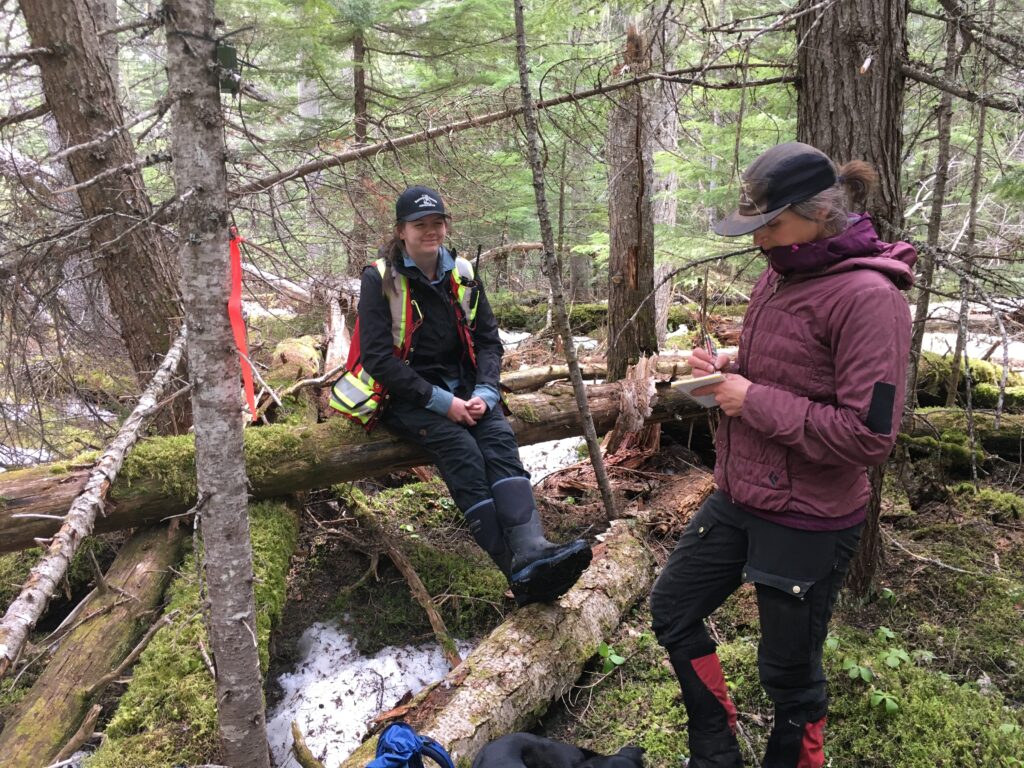
PHOTO: Biologist-in-Training McKenna Christianson evaluates a bird Acoustic Recording Unit (ARU) site with senior biologist Jen Atkins. Photo credit: Sybille Haeussler
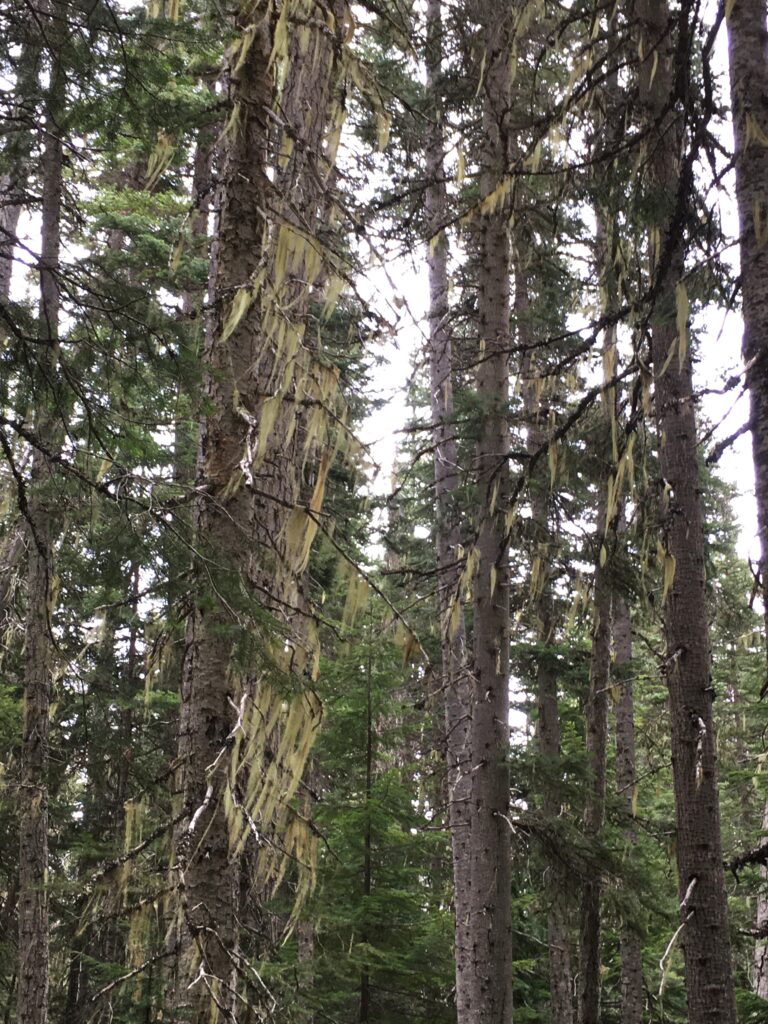
PHOTO: Old growth-associated Witch’s Hair Lichen provides winter food for Flying Squirrels. Will it thrive after partial harvest? Photo credit: Sybille Haeussler
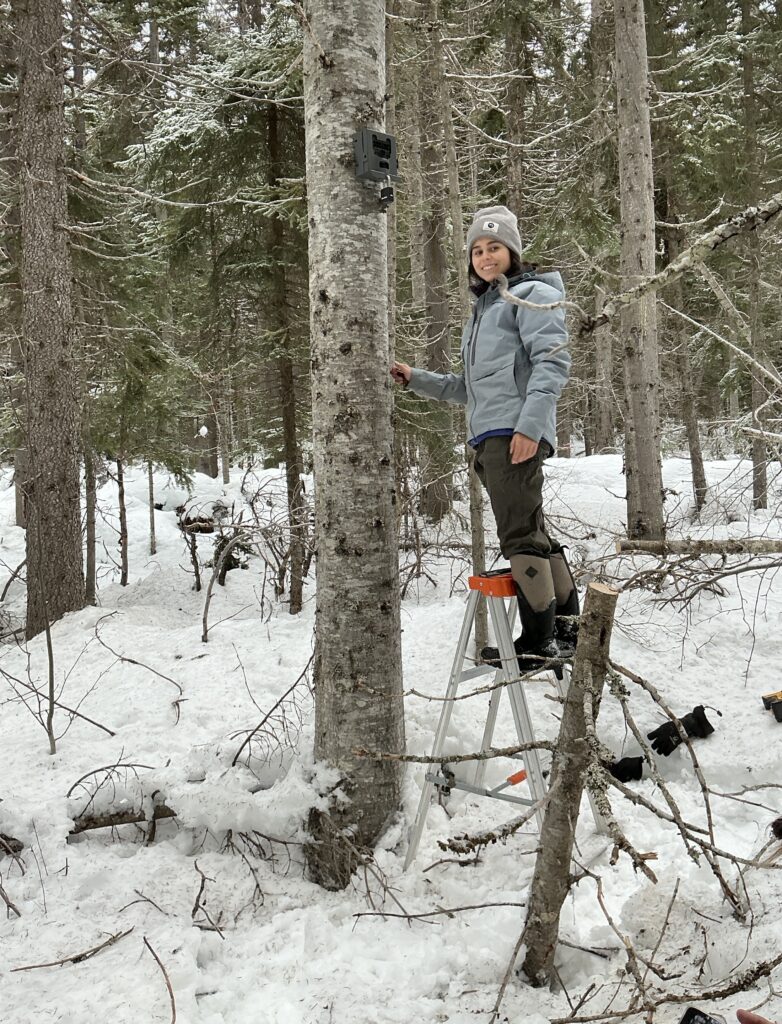
PHOTO: TRU student volunteer Brianne Ghuman installs a flying squirrel camera trap. Photo credit: Sybille Haeussler
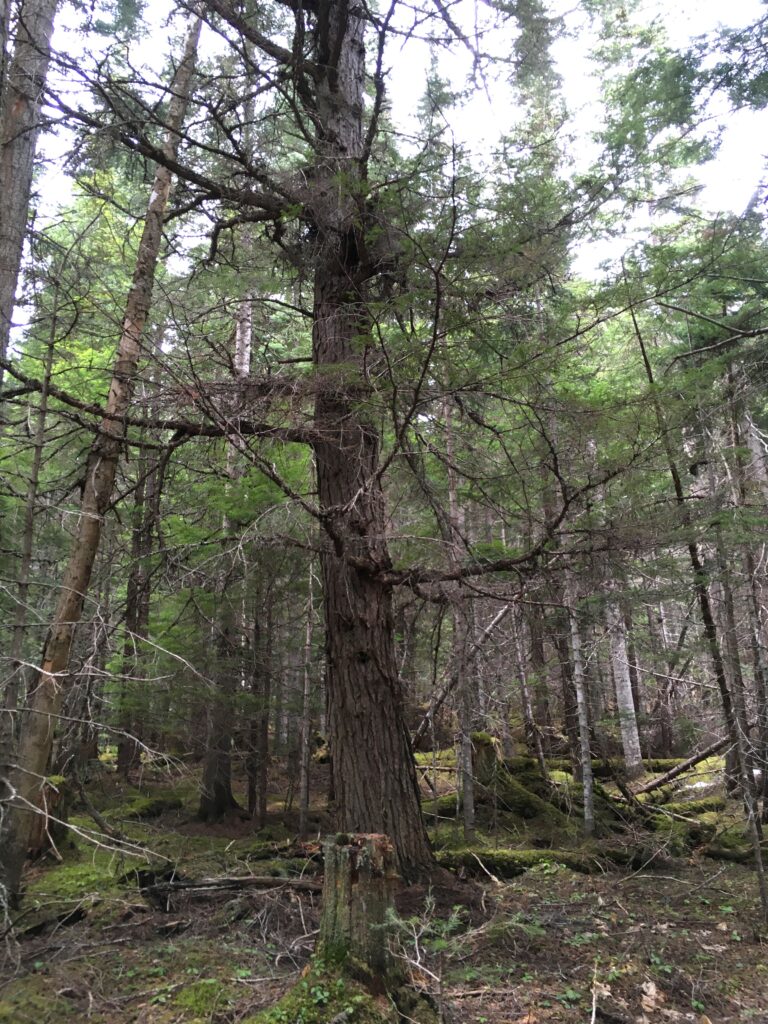
PHOTO: This mistletoe-infected Western Hemlock, retained after 1950s logging of more-valued Interior Spruce, has become a structurally complex wildlife tree Photo credit: Sybille Haeussler