

Overstory retention and climatic stress: effects on microclimate, biodiversity, and regeneration in forests of British Columbia
Project Title: Overstory retention and climatic stress: effects on microclimate, biodiversity, and regeneration in forests of British Columbia
Recipient: Mothertree Consulting Ltd.
Region: Multiple Regions
Theme(s): “Old-Like in a new light”
Awarded Amount: $40,000
Project Period: 2025-2027
Description: Climate change is affecting forests globally, but the degree to which silvicultural practices can help buffer these impacts remains unclear. This study will instrument existing silviculture experiments, including the “Mother Tree Project”, with microclimate data loggers to investigate relationships among tree retention, microclimate, biodiversity, regeneration, and productivity. These data will be used to assess geographic variation across a climate gradient and changes over time to quantify microclimate effects on biodiversity and productivity across silvicultural systems.
Halfway Reporting:
The following is based on halfway reporting by the grantee.
February 1, 2026
Exactly as it sounds, a microclimate is a localized climate within a small area that can differ from broader climates in the surrounding region. Microclimates provide refuge for many species, including animals, insects, and plants, that are especially vulnerable in a warming world. Forests are known to shelter them from extreme climates, through shading and protection by the large, old trees.
We began this project to uncover how microclimates in British Columbia’s forests are impacted by forest management practices and how forests can be managed for microclimates while still producing timber. The project takes place across the range of Douglas-fir forests in British Columbia. We installed temperature and humidity sensors in a variety of innovative harvesting treatments spanning British Columbia’s diverse climates that range from very hot and dry in the southeast, to warm and wet on the coast, to cold and dry in the north.
With support from the Silviculture Innovation Program, we purchased temperature and humidity sensors, the equipment needed to install them, and travel support to reach all our sites. Work began in spring 2025, when we engineered and installed 180 sensors across the study area. In August, we returned to download the first summer of data (and fix some sensors that were knocked down by curious bears!). These data allow us to begin seeing how different harvesting treatments cool or warm the forest understory compared to clearcuts and unharvested forests. Over time, this information will help us understand how temperature and moisture shift across different forest conditions, throughout seasons, and how these changes affect regeneration, resilience, and biodiversity. We hope to use this knowledge and share our findings with forest practitioners to help guide better forest management in the future.
We thank the Silviculture Innovation Program and National Science Foundation for financial support for this project and the researchers in the Betts Forest Landscape Ecology Lab at Oregon State University for their enthusiasm and contributions in launching this project. We also thank the Mother Tree Project crew for trekking across the province to install the sensors. We will continue to share updates through the Mother Tree Project & Program website and social media so please follow along!
We recently published a project overview on the Mother Tree Project and Program website: https://mothertreeproject.org/2025/12/12/mapping-forest-microclimates/
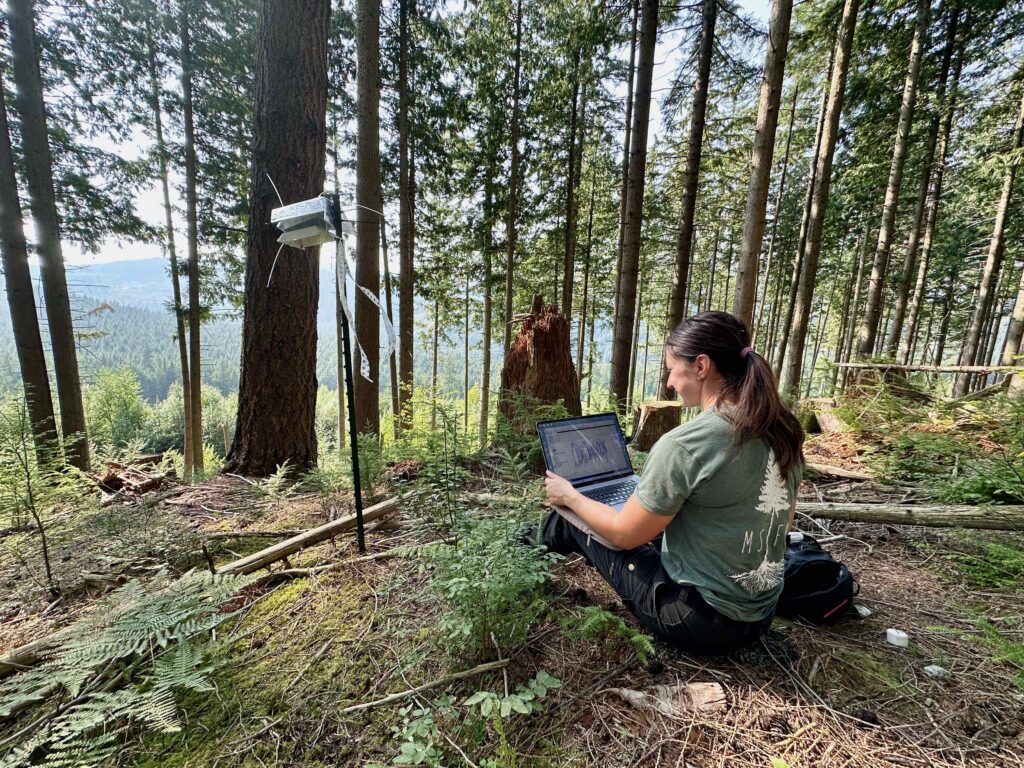
PHOTO: Downloading the first three months of temperature and humidity data in a 60% retention treatment. Photo credit: Suzanne Simard.
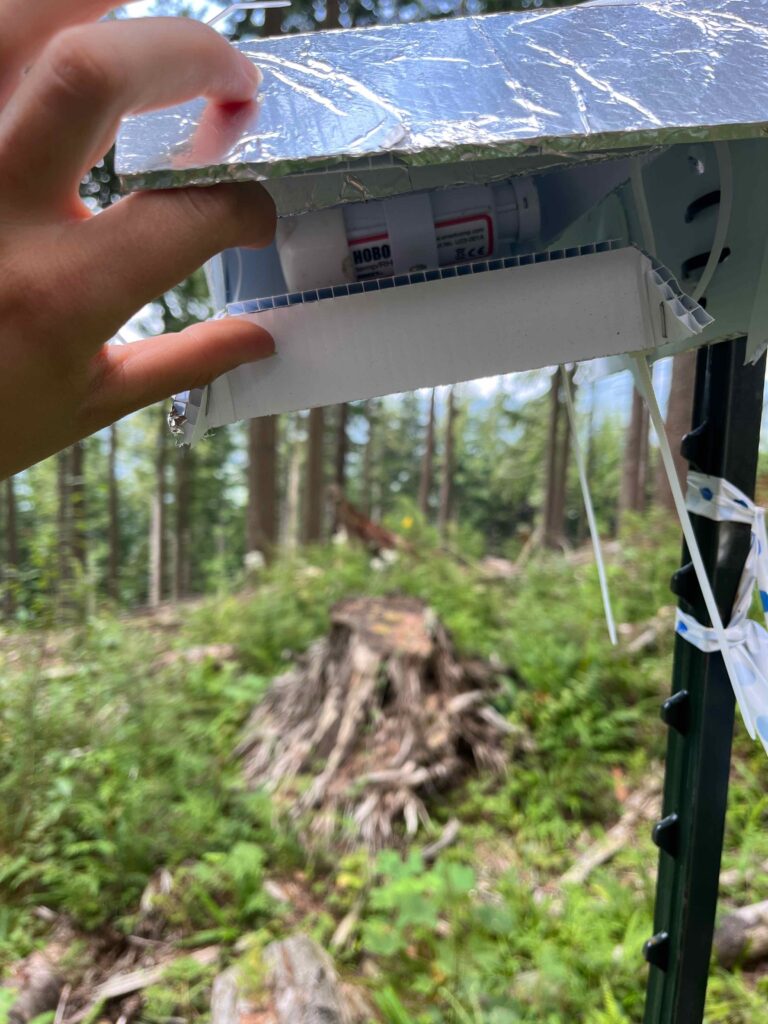
PHOTO: A temperature and humidity sensor inside a solar radiation shield. Solar radiation shields protect the sensor from overheating and recording extreme values that are not representative of the true climate conditions. Photo credit: Hannah Sachs
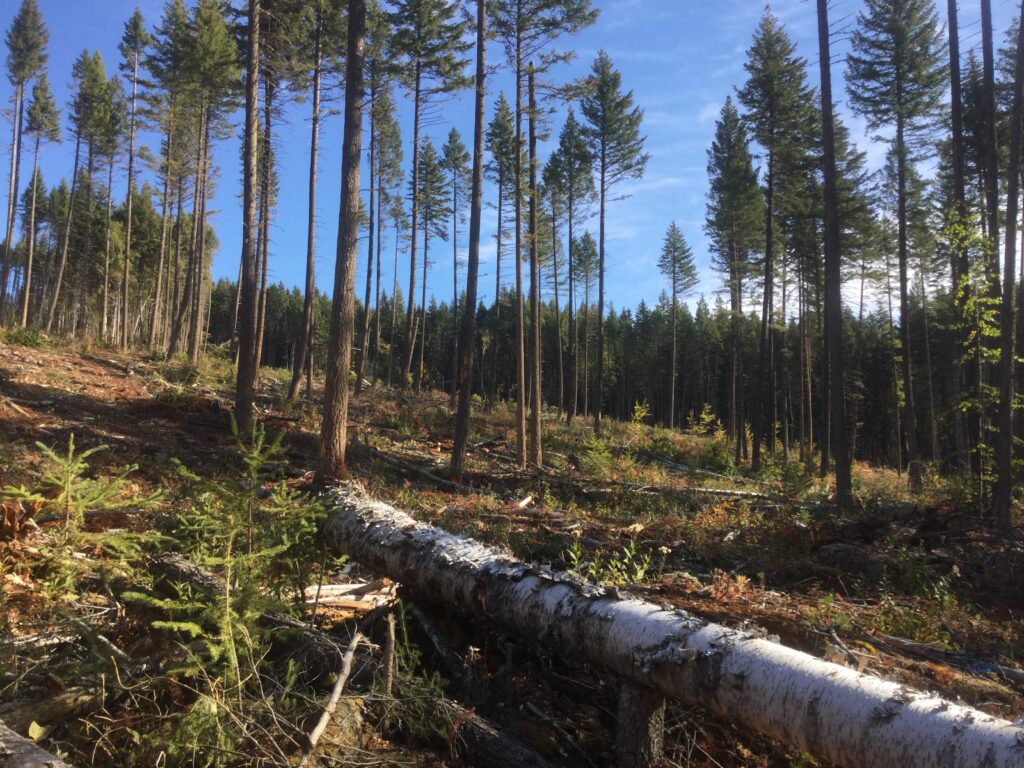
PHOTO: A 60% dispersed retention treatment after harvesting. A 30% clumped retention treatment is visible in the background. Photo credit: Mother Tree Project crew
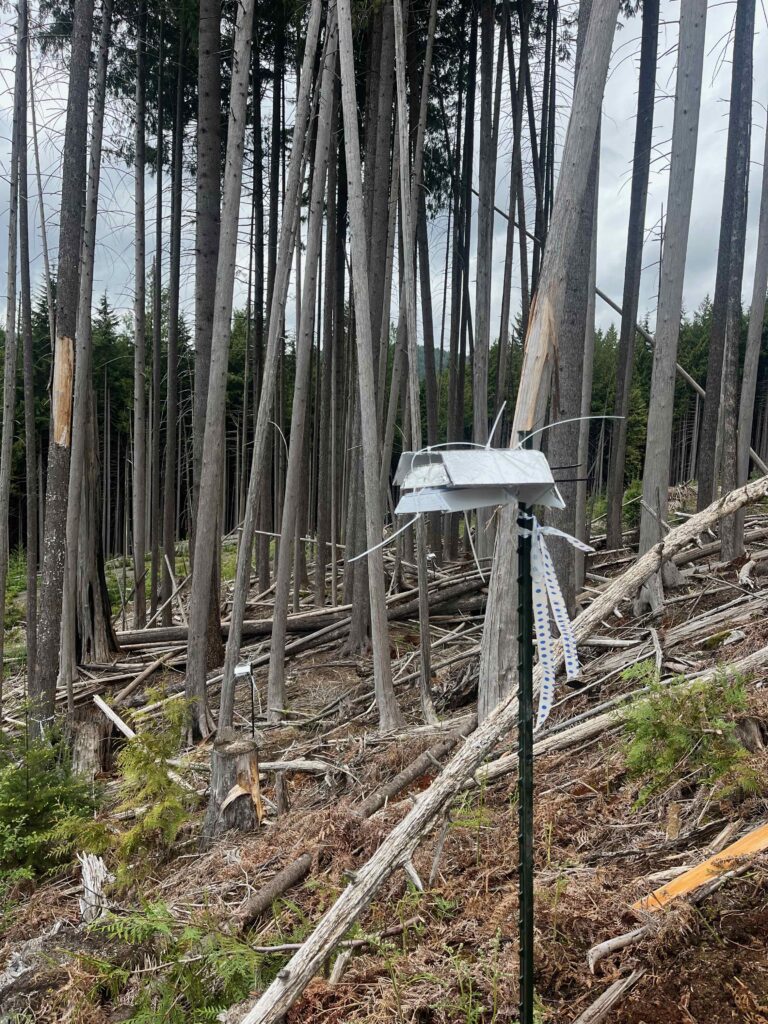
PHOTO: A sensor and solar radiation shield in a 30% clumped retention treatment. We are investigating how temperature and humidity change with distance to the clump edge in these harvesting treatments. Photo credit: Hannah Sachs