

A Holistic Approach to Thinning
Project Title: A Holistic Approach to Thinning
Recipient: Squamish Community Forest Corporation
Region: Mainland/Southwest Region
Theme(s): “Thin it to win it”
Awarded Amount: $40,000
Project Period: 2025-2026
Description: This project aims to identify priority treatment sites and develop prescriptions for forest thinning (pre-commercial and commercial) through a two-eyed seeing approach. Squamish Community Forest managers will work collaboratively with Squamish Nation lands and cultural team members to co-identify values and develop prescriptions. This work will contribute to operationalizing Squamish Nation’s Stséḵtsek Forestry Framework. High level goals for prescriptions include increasing biodiversity, reducing fire risk, improving stand structure and nurturing cultural values.
Halfway Reporting:
The following is based on halfway reporting by the grantee.
November 20, 2025
The “Holistic Approach to Thinning” project emerged to address overly dense second growth stands in Squamish Community Forest. The collaborative project, co-led by the Sḵwx̱wú7mesh Úxwumixw (Squamish Nation) Rights and Title and Cultural teams and the Squamish Community Forest management team, supports knowledge sharing for reflection of Sḵwx̱wú7mesh culture and ways of knowing in forest management. The project includes identifying priority treatment sites and co-developing prescriptions for thinning.
The project kicked off in March 2025 with a project planning and design meeting of members of the Squamish Community Forest management team and the Sḵwx̱wú7mesh Úxwumixw (Squamish Nation) Ta na wa Yúus ta Stitúyntsam̓ (Rights and Title) and Cultural teams. The group discussed overall goals for the project, how it connects with the Squamish Nation’s Stséḵtsek Forestry Framework and identified criteria for what type of stands to prioritize for thinning. We decided to consider two age classes (15-30 years and 31-55yrs). The young stand ages were chosen so to have more options in how to set stand direction, to avoid losing the understory vegetation to lack of light, and to maintain/enhance the tree growth.
A second criterion that arose was to focus on stands within biogeoclimatic zones that Squamish Nation has identified as high-risk i.e. ecosystems that contain less than 30% old growth forest in Squamish Nation territory. Within Squamish Community Forest that means the CWHdm and CWHvm1.
A third factor was to consider the Restoration Areas identified in the Squamish Nation’s X̱ay Temíxw Sacred Land Use Plan – i.e. areas that have been intensively logged in the recent past such that extensive portions of the watersheds are now second growth forests.
Goals of proposed thinning treatments include improving wildlife habitat, reducing fire risk, nurturing cultural values, supporting development of diverse stand structure, and increasing tree growth rates.
A map of potential areas to prioritize for thinning was produced by querying the identified criteria. The collaborative project team reviewed the draft mapping outputs and decided which polygons to prioritize for visits in the field. We looked for areas that could be accessible for educational purposes (as demonstration sites), for visits by Squamish Nation people for cultural gathering, and sites that have higher anthropogenic fire risk due to high levels of recreational use. A group of polygons between Garibaldi Park Road and Ring Creek North FSR was highlighted for field visits. These areas also happen to be located between areas that underwent wildfire risk reduction treatments just prior to the Squamish Community Forest tenure being issued.
On June 25, 2025 the team headed out for a field walk of the identified priority areas to confirm their suitability for pre-commercial thinning for the project objectives. The field visit began at one of the previously completed Wildfire Risk Reduction treatment areas. Here it was observed that, while the treatment was likely effective in reducing fire risk, that the remaining stand could have more structural diversity and understory plants. This provided a useful reference for what to consider in future thinning treatments.
Throughout the field visit to potential thinning stands the team discussed what features should be retained on site, which to nurture and what to remove. Squamish Nation members noted the importance of deciduous species – cherry, in particular, as a cultural use plant that also provides food for birds, and alder as good for the soil. Cedar was highlighted as a culturally valuable tree. Questions arose as to how well cedar is going to grow on these sites/at this elevation in the future, with climate change. Cultural use plants such as thimbleberry, salmonberry, raspberry, ferns, oceanspray and cascara were noted.
From the field discussions, direction emerged to:
- Leave a significant component of deciduous, especially cherry. It’s ok to remove some deciduous stems to focus on developing fewer larger trees
- Keep the larger Douglas Fir and Western Red Cedar – thin/remove the smaller stems around them to give them more space to grow
- However, don’t keep ONLY the larger trees. Also keep some of the smaller ones at reasonable density, to provide for future structural and age diversity in the stand.
- Look for and retain unique features
Subsequently, field surveys were conducted to collect more specific data for the development of prescriptions. We look forward to next steps of developing prescriptions based on the values identified by the group and reviewing those together.
Concurrent with the above activities, the project team has connected with researchers and students at the UBC Centre for Wildfire Co-Existence, as part of a study on effectiveness of wildfire fuel reduction treatments, and initiated conversations on research to assess how much of the thinned material can remain on site in this south coastal ecosystem, in what distributions, and still meet fire risk reduction goals. This aspect of the project will be elaborated further in the coming months.
Squamish Community Forest is grateful for the funding support from the Silviculture Innovation Program (SIP). The project is providing a great focus for shared learning and relationships building among the collaborative team members that will continue to benefit everyone into the future.

PHOTO: Dense young stand along popular bike trail – area identified for pre-commercial thinning. Credit: Sarah Weber.

PHOTO: Squamish Community Forest forester walks along a popular bike trail through a dense young stand.. Credit: Sarah Weber.
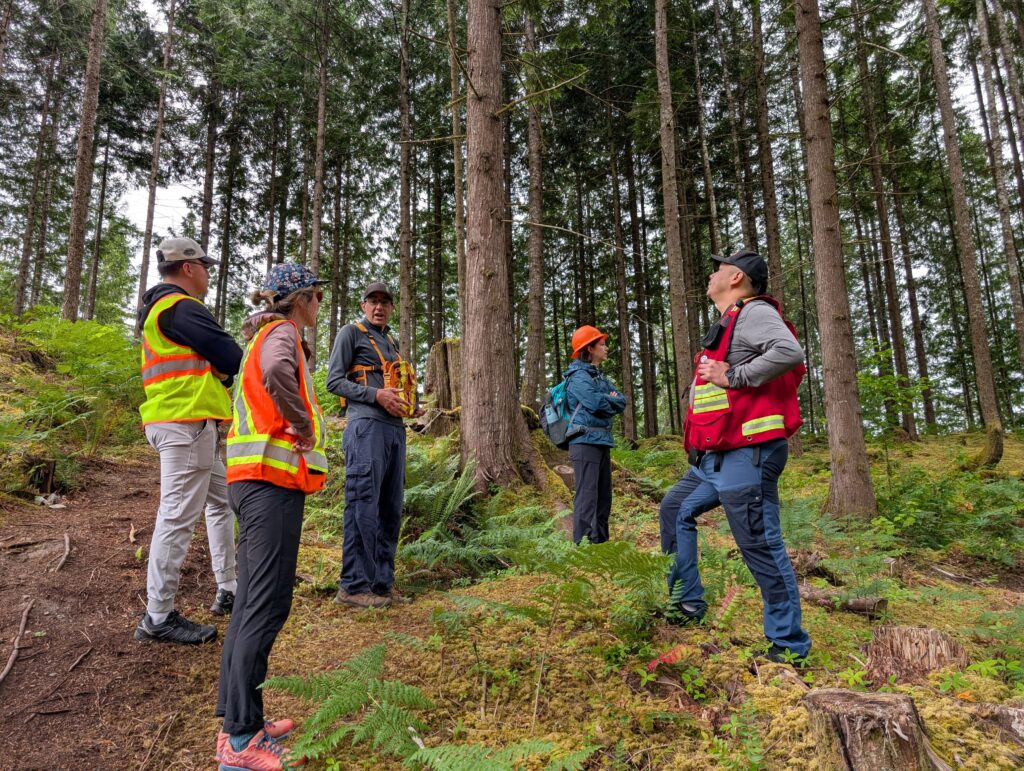
PHOTO: Collaborative project team visit to previously fuel thinned stand, adjacent to areas proposed for future thinning. Credit: Sarah Weber.

PHOTO: Sḵwx̱wú7mesh Úxwumixw (Squamish Nation) Ta na wa Yúus ta Stitúyntsam̓ (Rights and Title) team members and guest from UBC discuss thinning goals with Squamish Community Forest forestry team. Credit: Sarah Weber.

PHOTO: Traversing a gully between thinning polygons during June 2025 field visit. The diversity of stand ages and structures adjacent to proposed thinning areas provides a great comparison and learning opportunity. Credit: Kelsey Copes-Gerbitz.