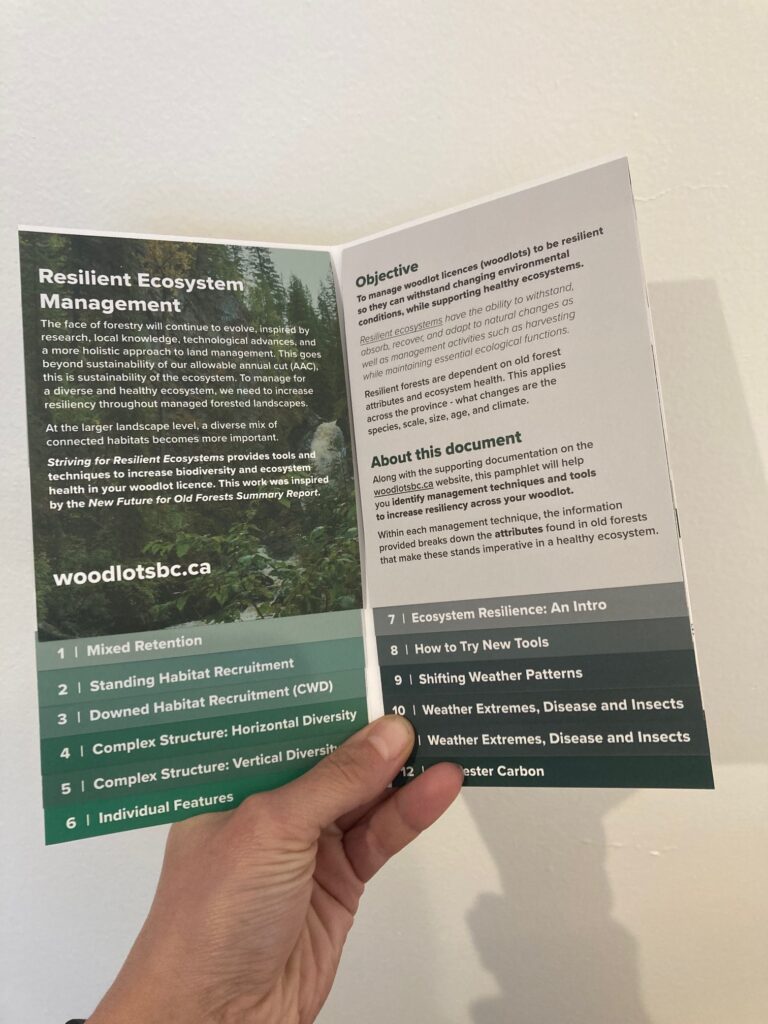
Old growth attributes and best management practices pamphlet
Project Title: Old growth attributes and best management practices pamphlet
Recipient: Woodlots BC
Region: Provincial
Project Period: 2025-2026
Awarded Amount: $8,500
Description: The project is to provide information on old forest attributes and best management tools to maintain resilient old forest attributes within a harvest unit. The final product is pamphlets outlining attributes and best management practices to use operationally. Woodlots BC will also provide background information and links to other resources on their website.
Final Report:
The following is based on final reporting by the grantee.
March 31, 2026
How do we manage our woodlots to be resilient so that they can sustain forests with old forest attributes. To be sustainable, those forest attributes must always be available within the woodlot. To be either sustainable or resilient the ecosystem must be healthy. Some woodlots have lots of Old Forests to choose from, and others have very little due to fire, pests or pathogens. It’s a big, heavy topic and diverse just as BC’s forests are diverse. The Old Growth Strategic Review report that was released in 2020 identified several types of forests that should be deferred from harvest to protect their ecological values. These forest types include:
- Big-Treed Old Growth: Forests with large, old trees.
- Priority Big-Treed Old Growth: A subset of Big-Treed Old Growth with exceptional ecological values.
- Ancient Forest: Forests with trees that are over 400 years old.
- Remnant Old Ecosystems: Forests that have survived past disturbances and have unique ecological features.
- Intact Watersheds: Forests within watersheds that have not been significantly altered by human activities.
- Big-Treed Recruitment Forest: Forests that have the potential to develop into Big-Treed Old Growth in the future.
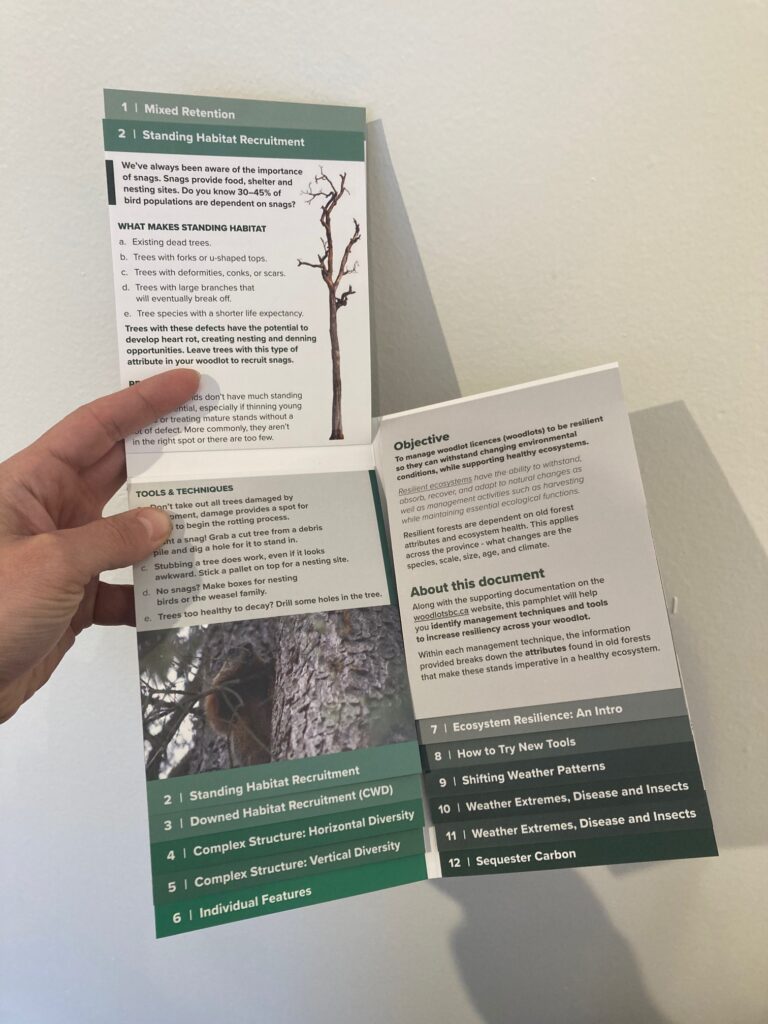
In 2022, Woodlots were exempt from priority old-growth big tree polygons except where there is overlap with ancient or remnant polygons. We have been operating under this ever since. As woodlotters we need to show that we are meeting the intent of the A New Future for Old Forests and Draft BC Biodiversity and Ecosystem Health Framework without legislation and policy. Otherwise, there is a case for the government to rescind our exemption. Within those documents there are recommendations. They are meant to guide and as a tenure group, there are pieces that we can achieve on our land bases. One such recommendation is: Create a silviculture innovation program aimed at developing harvesting alternative to clearcutting that maintain old values. In order to put you, the licensee in the driver’s seat and showcase a license that is about healthy, diverse ecosystems with the added benefit of supporting your local economy with logs, we’ve done literature review and are going to share that with you this year in order to up your game. Throughout 2025 and 2026 we are publishing articles focusing on topics that will help you create and develop Old Forest Attributes throughout your woodlot to meet recommendations, increase biodiversity, and strengthen ecosystems. We’re also published a pamphlet with the support of a SIP grant to spread the concepts and start the conversation. This pamphlet outlines 6 Old Forest Attributes to maintain in a harvested area and 6 higher level management tools to help manage through external factors such as climate change. The pamphlet was released at the 2025 October Woodlots BC Conference. It was well received and we are almost out of pamphlets. We’ve had a number of major licensees ask if they can distribute them to loggers and how to get more copies printed. We are getting a quote to design the information into a printable format for the website and mobile use.
Supporting Extension Materials:
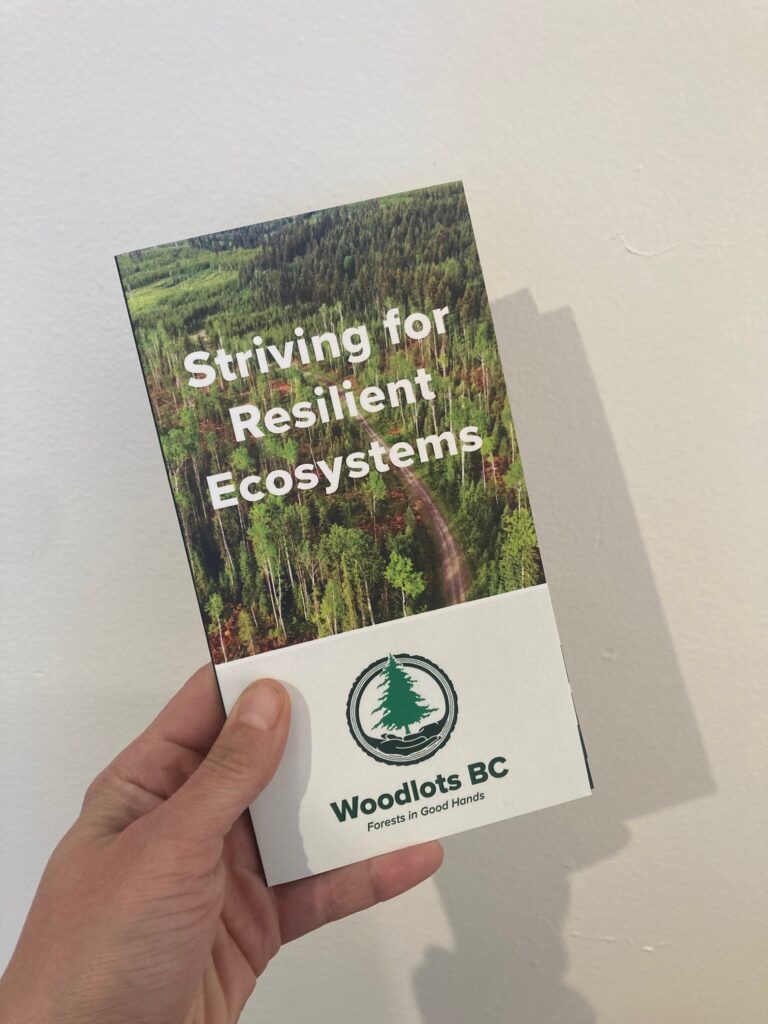
- Pamphlet Version: Striving for Resilient Ecosystems
- Booklet Version: Striving for Resilient Ecosystems
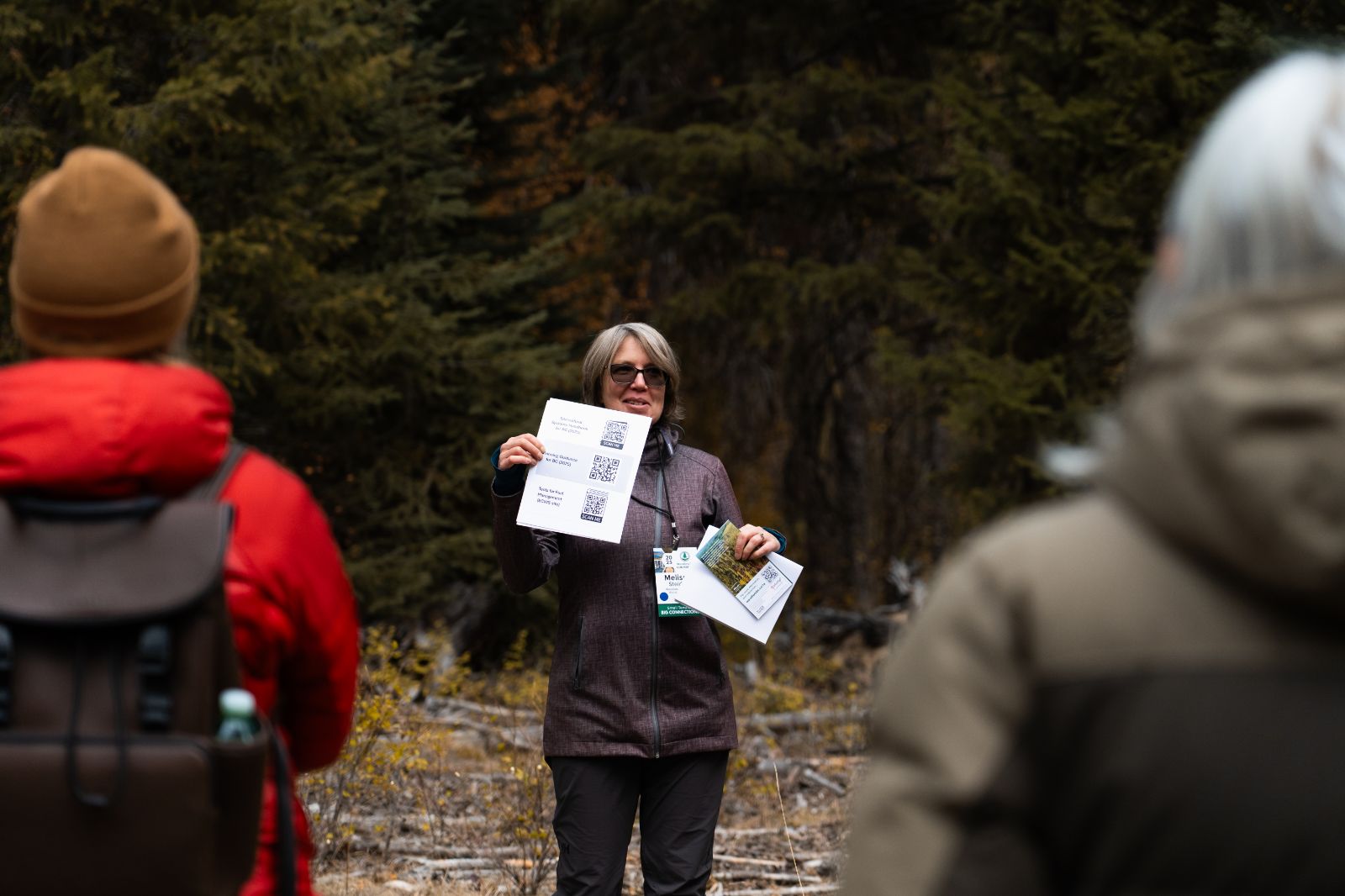
Photo: Melissa presenting the pamphlet on a field tour at the Woodlots BC conference. Credit: Woodlots BC.
HALFWAY Report:
The following is based on final reporting by the grantee.
February 10, 2026
The project is completed. The goal was to have the pamphlets printed by the Woodlots BC Conference in October. The pamphlets arrived at our doorstep the day before we were leaving for Osoyoos. The flipbooks were printed in Germany and took some time clearing customs in Vancouver.
The flipbook was part of a project undertaken by Woodlots BC and has an accompanying website with articles and research information being added over time. We have included an introduction article written for our members introducing our Resilient Ecosystems project.
Over time we will have an article for every flip tab in the book that will be on our website, published in the Almanac and sent out via our weekly email.
The pamphlet had a very positive response and the information within it was actually spoken about through a number of the speakers without any coordination. The information is timely and needed as we continuously learn to be better woodlot caretakers.
We have had a local major licensee reach out asking if they can get some printed for their contractors, each of the woodlot regional reps left with less than a box after the conference. I thought that the 550 flipbooks I had printed would last quite some time (and was worried I’d have boxes left over for years to come). We are now asking people to not throw them out, but rather pass them on!
The experience was very valuable. The committee was full of keen woodlotters, scattered from across the province. The designer is located in Vanderhoof and as a biologist turned designer was quite able to take our ideas and turn them into succinct tabs in the flipbook. This was very much a literature review and the website will back up the information in the flipbook when people want to see the original papers.